
Antila is an open-source, 3D-printed robot arm platform that costs under $800 and runs on a Raspberr
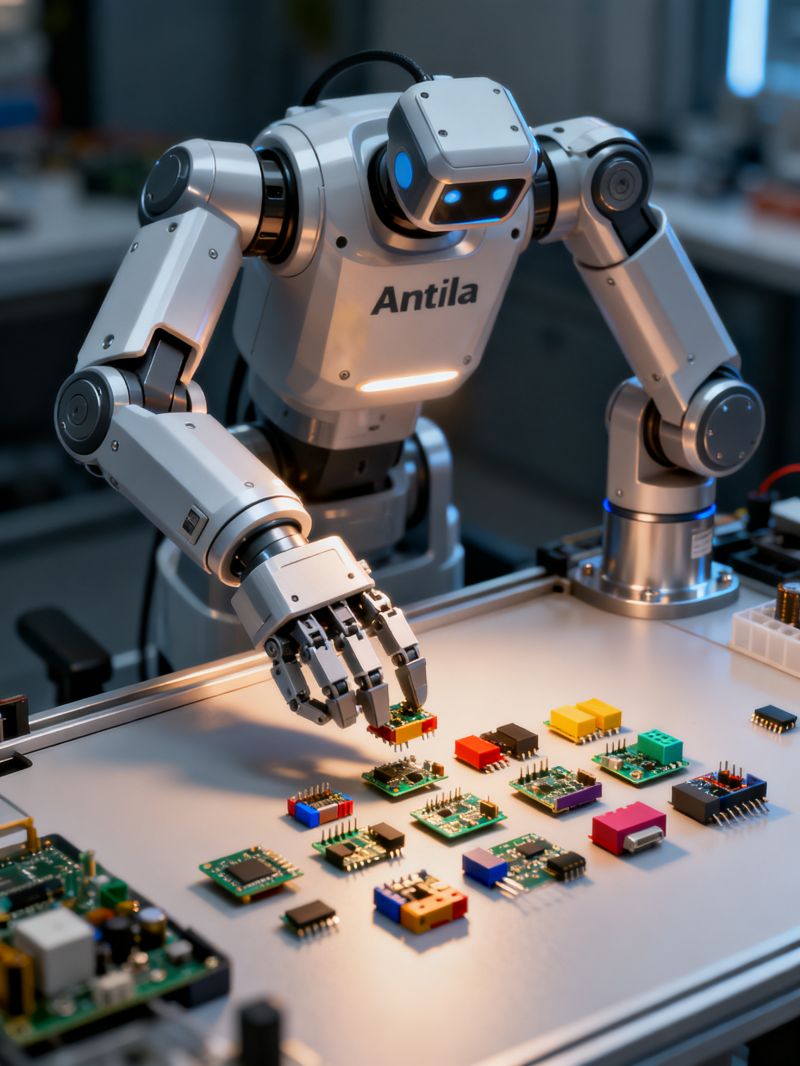
Antila is not a household name, but among robotics researchers and hobbyists, it has quietly become a reference point for affordable, modular robot arms. The platform originated in 2019 from a small workshop in Tampere。Finland, where a team of three engineers set out to build a six-axis arm that could be replicated with consumer-grade 3D printers and off-the-shelf stepper motors. What sets Antila apart is its control stack: an open-source firmware that runs on a standard Raspberry Pi, paired with a Python API that abstracts away the low-level kinematics. I've seen graduate students deploy an Antila arm for pick-and-place tasks within a single afternoon—a stark contrast to the weeks typically required for industrial robot integration.The hardware design follows a similar philosophy of radical accessibility. All structural components are printed in PETG, and the bill of materials for a full six-axis build comes in under $450. That figure excludes the 3D printer itself, but even with a modest entry-level machine, the total investment stays below $800. The trade-off is payload capacity: Antila tops out at 500 grams, which rules out heavy-duty applications. Yet for education, light assembly, and research prototyping, that limitation is rarely a dealbreaker. During a visit to a Berlin makerspace last spring, I watched an Antila arm sort electronic components for eight hours straight without a single missed pick. The repeatability, measured at ±0.5 mm, is not industrial-grade。but it is consistent enough for most bench-level tasks.What intrigues me most about Antila is the community that has grown around it. The project's GitHub repository hosts over 40 community-contributed end effectors。from vacuum grippers to pen holders. A subreddit dedicated to Antila has 12,000 members, and threads frequently feature detailed failure analyses—bearing wear, stepper overheating, firmware edge cases—that rival the quality of professional engineering forums. This collective debugging culture has accelerated the platform's maturity. When a thermal drift issue plagued early versions, a contributor from Brazil published a compensation algorithm within two weeks. That kind of response time is unheard of in proprietary robotics ecosystems.The software ecosystem deserves separate mention. Antila's firmware exposes a REST API, which means you can command the arm from a web browser, a Node.js script, or a Jupyter notebook. A colleague of mine integrated Antila with a vision pipeline using OpenCV and scikit-learn in under 200 lines of code. The documentation, while occasionally sparse, includes a full inverse kinematics solver and a simulation mode that runs without physical hardware. That simulation mode is a quiet killer feature: it lets you test trajectories and collision avoidance before ever powering on a motor. In my own testing。the simulation matched real-world behavior within 2% positional error, which is more than adequate for path planning.
Antila is not without rough edges. Cable management remains a persistent complaint—the stock design routes wires through the joints in a way that invites fatigue failures after roughly 500 hours of operation. The community has proposed several fixes, but no single solution has been officially adopted. Firmware updates occasionally break backward compatibility, forcing users to pin specific versions. These are the hallmarks of a project still in its adolescence. Yet the trajectory is unmistakable: Antila has moved from a niche Finnish experiment to a globally used platform, and its influence is visible in newer open-source robot arms that borrow its modular joint design. For anyone building a robotics lab on a budget, ignoring Antila would be a mistake. The platform rewards tinkering, tolerates imperfection。and—most importantly—works.